

Pigment and Plasma 2
Ep 2: After Hours – A Dangerous Spark

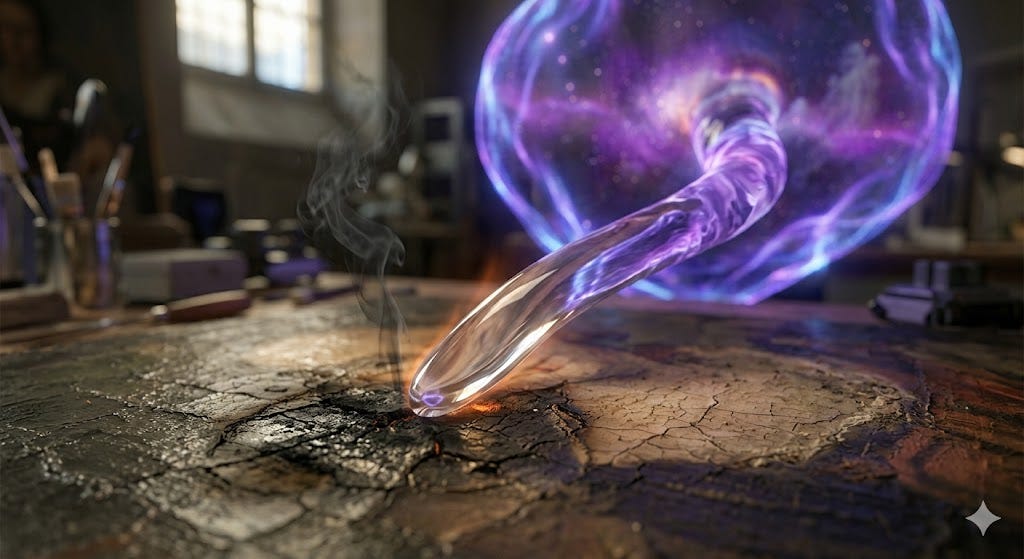
Tullius went to his workroom after closing the museum. Now fully charged, xe had any energy xe might need for cleaning or repairing would be available.
Xe particularly liked physical things, like the teapot, but now xe took out an ancient oil painting, much damaged and cracked from the improper storage and from the use of thick impasto. First xe waved xir energy field above the surface of the paint, absorbing dirt and grime. The photons reflected more saturated vibrations once the grime evaporated. Then xe carefully lifted layers of dried resin varnish, again revealing intense colors and delicate shading completely hidden before.
Tullius perceived the layers of paints below the surface, a common trait of such artifacts. Xe was careful not to disturb the surface image, but xe did scan the underlying layers for provenance of construction. Accurate records were essential for curation in the museum’s archives.
Xe planned to repair the cracks at the molecular level, softening the ancient oxidized hydrocarbons just enough to push the cracks together. Xe extended a tiny tendril of energy and pulled the heat from it into xir core. After first warming the interior of the crack, xe cooled the tendril softly to solidify it as xe had done with the teapot. Gently xe pushed the edge of the crack closer to the other side, and then pushed the remaining space to meet. The seam was invisible, perfectly realigned.
Xe started on another, larger crack, still working on the edge of the painting. Again softening, pushing, restoring. Excited by xir success, xe started on another crack, just one more before discharging more heat to keep the tendril cool.
The sensation of touch was exhilarating, like no other sensation from his electromagnetic spectrum. Then the paint darkened and a haze of carbonized vapor rose from the crack.
Tullius jerked the tendril back into his core, but not quickly enough to avoid damage. A black ring circled the crack, the hydrocarbons releasing the vapor, changing the pigment hues, and leaving a hole in the textile substrate.
Tullius shrank into xirself, fighting to contain the heat leaking through the electron cloud that formed xir body’s barrier. Panic raised xir temperature. Xe surged from the workroom to vent heat into an exchanger that powered the museum’s displays. Xe should have vented sooner. What would xe do now to repair the painting? Could xe make such repairs? What would xir boss say?
You are here to curate artifacts, not burn them. Tullius imagined Aurilion’s stern voice in his processing space. Xir boss must not find out what xe had done.
This hadn’t happened before, but the teapot had gotten warmer, despite the careful condensing so that the woman could touch it. Xe didn’t realize such a short touch would trigger the alarm.
Questions flooded xir processing space. How to repair the artifact? Should xe record the damage and then make the repair? If xe didn’t report it, could xe repair it enough to hide the burn damage? Could xe repair it without more damage?
But xe had felt the softness of the melted hydrocarbon, the fine dust of the pigment. Xe had moved it, not just a few molecules, but the substance itself. It felt good. It felt real.
Tullius continued feeding heat into the exchanger until it hummed. Xe had dimmed from the effort of channeling heat and the effort of condensing the tendril.
Xe must calm xirself. Plans formed about how to use samples of textiles, hydrocarbons, and pigments in the painting to replace the burned spot. A centimeter of an artifact was a lot to fill in, and there were still cracks to repair.
Xe needed a lot of practice and some kind of heat gauge to make sure this never happened again. Skipping much of xir recharge cycle, Tullius worked on the repairs, only a few seconds at a time.
Removing the burned spot was the most difficult and resulted in a larger damage zone. The paint that near the burn had changed hue, some characteristic of the pigment involved. Xe could make more pigment, but xe could not make it the same carbon date without sampling the painting itself, risking more damage.
Molecule by molecule, xe recreated the textile, the substrate paint, and finally, filled in the bits of the ruined paint. It was time to open the museum, and Tullius had dimmed to half xir brilliance.
As xe made xir way to the solar arrays, part of xir morning duty, xe realized that the scans of the painting had not been stored in the archive. Xe did not remember how it had appeared or exactly where the third crack had been. Xe felt xir electrons close in on the atoms of xir core, dimming xir more.
A message came through the comm system: A group of Arcturian scholars were arriving momentarily. Xe needed to recharge. Xe needed to close off xir workroom. And xe needed to please the demands of the scholars, most of whom discounted any individual who was not solid.
The displays would be well-supplied from the batteries as well as the artifact force field, so recharging xirself was first priority. The charging station was near the foyer, so xe would be ready for the group. Xe soaked in as much ultraviolet light as possible while watching the shuttle arrive at the airlock.
Xe must prepare xirself for any comments, staying professional at all times. They would no doubt tell xir what they wanted to see, but xe had a plan.