

Pigment and Plasma
Ep 1: Museum Earth – Echoes in the Clay

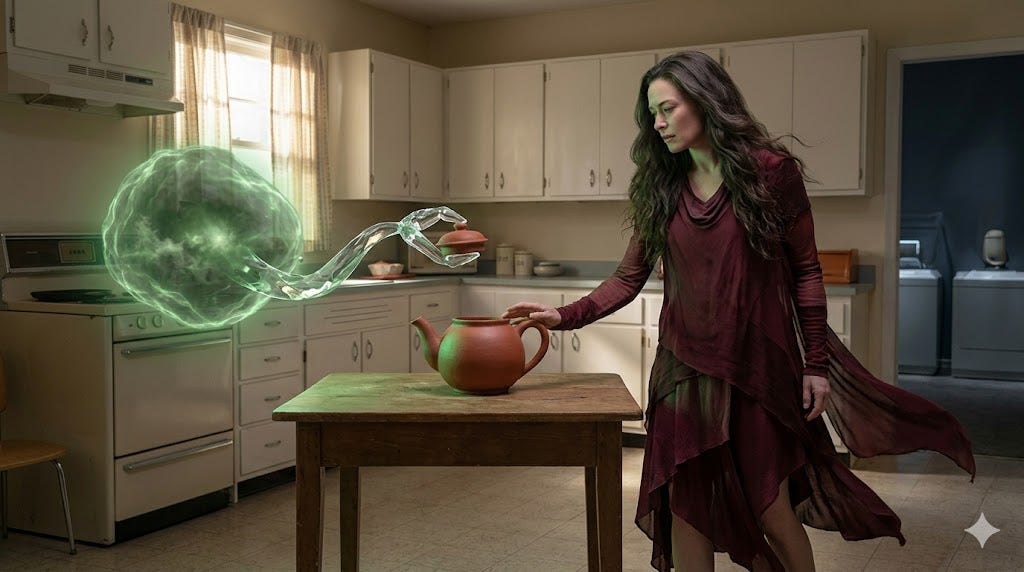
Tullius’s plasma form flowed through the mechanics to orient the museum’s solar arrays to power the exhibits and feed xirself with UV radiation for the day’s duties. Xir art created the virtual realities, which brought visitors from across the galaxy to see the glory of Ancient Earth before it had been ravaged and abandoned.
Creating the virtual art had become routine, so that xir spent more and more time with the physical artifacts. Xe removed detritus, often making repairs at the molecular level. Xe analyzed elements, sensing the materials, but also the emotional resonance some of them carried.
However, xe could not touch the clay teapot, feel the weight of it, pour in liquid, or drink from it.
Tullius craved physical substance—a human body, with all its inconvenient limitations created the depth of sensory experience. A manufactured spoon hummed with repetition of forging, polishing, using. Art was different. It carried delight, struggle, even pain. Analyzing and replicating the materials did not bring that resonance.
The Galactic Arts Council cared only for the virtual. Clean. Safe. Ordered. Xir job preserved history, not participate in it.
Tullius desired to be a storyteller to the galaxy. What xir boss, Aurilion, did not know would not affect xir work.
The museum interface informed xir that a visitor had arrived. Xe greeted a human female, adjusting the life-support for her comfort.
“Would you prefer that I take on humanoid shape to guide you through the museum?” asked Tullius. “Some visitors find my form distracting.”
“Oh no, you are so beautiful,” she said. “Are you a construct?”
“I am plasma being; this is my natural state.”
“Then stay as you are.”
“Have you a particular interest to explore?” Xe extended an appendage as a pointer. “Art? Machinery? Music? Domestic Objects? Or a general tour?”
“Show me the Domestic Objects. My grandmother told me of the many things she used, and the memories connected to them.”
Tullius led her to a 20th century kitchen reproduction, though it would be far earlier than the woman’s grandmother.
She stared at the artifacts with a mix of recognition and bewilderment, familiar objects rendered strange by their context. She pressed her hand to the viewing barrier, murmuring about the kitchen window, the slightly moving curtains, and the simulated sunlight on the tile floor.
Tullius changed the lighting slightly to be warmer, sunnier, flowing through the window to shine on the artifacts: a teapot, a towel, and several pieces of flatware.
The detailed narratives Tullius shared told of preparing food, of serving it, how humans used each artifact.
“It looks so homey,” she said, smiling, but then her expression changed. “But nobody cooks here.”
Tullius shifted color, hurt. “There is no one here to cook for, and cooking would damage the exhibit.” Xe gestured to the displayed artifacts. Safe within force fields, not reproductions, each artifact showed wear from use. One was a simple red clay teapot, still containing the stains of the tea brewed inside.
The woman stared, breathless. “My grandmother had one like that, from her great-grandmother.”
“It is hand-formed clay,” Tullius said. “Late in the industrial period, but many artisans…”
“No, someone used this. Made their tea in it, shared with friends and family.” The woman’s voice trembled. “I wonder whose it was, what stories it listened to as they came together.”
Tullius had analyzed the pot before, heat, habit, even companionship, both of the maker and the users. None of it helped xir answer. Xe did not want to share xir story or the destruction around xir provenance. Xe did desire to use it, to serve her tea—if such were still available or could be replicated.
Not here. Not now. Not ever.
Why could xe not build in a virtual experience of that? It was forbidden. Xe hesitated. Aurilion’s orders warned at the edge of xir awareness. Xe turned off the force field. No one was here but the woman.
Xe focused will power to a tendril xir extended toward the teapot. Boundaries formed. Density gathered around thought. Light narrowed to minimal spectrum. A limb slowly condensed. Xe felt at once: pressure, temperature, gravity.
The woman’s mouth dropped open and her eyes were wide. “How can you do that?”
“It is a thing we can do.” But one that we are never supposed to do.
Xe picked up the teapot, judging temperature, pressure, friction, and balance, so as not to damage it. The teapot felt cool at the bare terracotta rim on the base and around the lid, with an imperfect glaze, textured, worn with use, stained on the rim with the brewing of the beverage. Setting it back on the display, xe removed the lid to let her look inside.
Xe let the woman touch the teapot, although he held it safely. Xe would absorb her DNA residue again as soon as she left, no damage done.
“It’s warm, just as if someone had just made tea,” she said.
Amber light filled the room and an alarm sounded in his mind: UNAUTHORIZED MATERIAL CONTACT. Xe jerked, nearly knocking the teapot from the display.
The woman’s face changed to sadness. “”Memories connect with things,” she said, “That is what Granny meant.” Her choked voice and dripping tears marked her emotions.
Tullius could feel her joy and sadness, longing and desire. Xe reabsorbed xir hand to turn the field back on, the sensations gone, but not the memory of them.
Touching the woman would injure her. Xe waited for a few minutes until her vibrations calmed.
“Do you think anyone still makes such things as this?” she asked. “Perhaps I could learn to make something with my hands, maybe not so well, but something.”
Tullius made xir voice as reassuring as possible. “I am sure that artisans still exist who could teach you. Some cultures highly value artisanal processes and artifacts.”
She nodded, still gazing at the teapot. After a few seconds, she asked to see another section, living areas, bedrooms, even waste facilities, all of which were so primitive to her eyes. “We have come a long way,” she said.
“Yes, all of us have evolved and changed.” Perhaps not always for the better.
***
Tullius watched the human visitor depart. Humans’ ephemeral nature, their ability to create, to experience, to feel within their limited lifespan, drew xir in. In every shared story, Tullius glimpsed the richness of the human spirit, and now yearned for more.
But Aurilion would know about his condensing and would discipline xir. Xe had to be much more careful.